
Krakow gets sold to outsiders as a weekend: a stag party on the Rynek, a day at Auschwitz, a salt mine, a beer in the Cloth Hall, then home. That's a heavy, memorable trip and very nearly no help if you actually live here and want to meet someone. So let's swap the itinerary for the structure. What really governs dating in Krakow isn't the dragon legend or the trumpet call from St Mary's — it's four unglamorous facts most guides skip: a compact medieval Old Town wrapped in the Planty park ring, small enough to cross on foot in twenty minutes; the Jagiellonian University, founded in 1364 and one of the oldest in Europe, anchoring a student population well into six figures across the city's universities; Kazimierz, the former Jewish quarter turned bohemian engine of cafés, bars and courtyards; and one of Central Europe's deepest café cultures, where sitting for hours over one coffee is a respectable way to spend an afternoon. Read those four correctly and Krakow stops being a stag-do backdrop and becomes one of the easiest small cities in Europe to actually meet people in — provided you build a routine inside it rather than treating it as a film set.
Begin with the evidence, because it points where the postcards don't. One of the most replicated findings in relationship science is the propinquity effect — we form bonds with the people we are physically near and encounter repeatedly. Festinger, Schachter and Back documented it in 1950 in a study of a student housing complex, where sheer physical proximity predicted friendship far better than shared interests did. It rests on the mere-exposure effect, which Robert Zajonc later demonstrated in the lab: we reliably warm to faces we keep seeing, no persuasion required. Krakow is built for this. The Old Town is tiny and walkable, the Planty ring funnels everyone along the same green loop, and the enormous student body guarantees the same faces cycle through the same cafés, lecture halls and Kazimierz bars week after week. A city this dense and this young is, in effect, a propinquity machine — it hands you repeated contact whether you ask for it or not. What it can't hand you is the nerve to say something the fifth time you see the same person at your local on Plac Nowy — and that, as always, is a personal problem, not a civic one.
"Krakow is small enough that you cannot stay anonymous in it, and for dating that's a gift. The same faces pass you on the Rynek, around the Planty, on Plac Nowy in Kazimierz, week after week. The whole game is building a routine inside that loop — and being brave enough to use it."
— Morten Andersen, LoveCertainHow Krakow actually shapes the dating math
Here's the honest version. Krakow's defining structural fact is the student calendar, and it governs the dating year more than the weather does. Term time, roughly October to June, is when the city is fullest, youngest and most sociable — Kazimierz humming, every café busy, the propinquity engine at full tilt. Summer flips it: a chunk of the student population goes home, the centre fills instead with tourists, and the social life of residents thins out or moves to the Vistula boulevards and beer gardens. The practical lesson is to front-load your dating life into term time, when the city hands you repeated contact for free, and to keep a hardier summer anchor — a riverside running route, a sport, a regular bar that stays local — so your repeated-contact loop doesn't reset to zero. The second fact is the churn all those students bring: a real share of any young social circle is mid-arrival or mid-departure at any given moment, which is a reason to build repeated contact quickly rather than a reason for cynicism.
Then there's the café-and-Kazimierz texture, which genuinely sets Krakow apart. The honest read on the apps, per Eli Finkel's research, is that their matching algorithms predict real-world chemistry far more weakly than the marketing implies — and Krakow's whole social design routes around them anyway. The café is the city's native low-stakes meeting format: nobody hurries you, a coffee can become three hours, and conversation rather than performance does the work. There's also a real self-expansion angle close at hand: Arthur Aron's research on self-expansion found that couples who do novel, mildly challenging things together feel more alive than those who don't — and Wawel, the Vistula, and an easy train south to Zakopane and the Tatras keep that kind of novelty within reach. One more idea is worth borrowing here: Caryl Rusbult's investment model, which finds that commitment grows not just from how happy you are but from what you've built together and how few alternatives loom. In a student city where the pool can feel endless, that's a useful corrective — the people who pair up well here tend to stop treating the next match as automatically better and start investing in the one in front of them.
Across the developed world, work by sociologist Michael Rosenfeld and colleagues finds that meeting online has become the single most common way couples now find each other, overtaking introductions through friends. Krakow leans a little against that grain: the dense student population and a strong café-and-courtyard social life mean a lot of couples here still meet through study, work, and the Kazimierz scene as much as through apps. The apps help reach the steady stream of new arrivals each autumn, but in a centre this small the pool feels familiar fast — which is exactly why the offline, café-and-Planty route still carries real weight. Geography and routine — your neighbourhood, your local, your weekly thing — decide whether it happens.
Best areas to meet people
The Rynek Główny — one of Europe's largest medieval squares — plus the Cloth Hall, the surrounding lanes and the green Planty park that loops the whole centre. Central, walkable and busy year-round, it's the most reliable place to keep crossing paths with the same people, which is precisely the repeatable terrain the propinquity research rewards. Touristy at the very core; quieter and more local on the Planty and the side streets.
The former Jewish quarter, now the city's bohemian heart — courtyards, vintage shops, a dense run of cafés and bars around Plac Nowy with its famous zapiekanka hatch. Younger, scruffier and more sociable than the Old Town, and the part of Krakow most likely to turn an acquaintance into a regular. The single best district for building a low-key, recurring social loop.
The Bulwary Wiślane riverbanks below Wawel come alive in the warmer months — walkers, cyclists, barge bars and picnics — while Podgórze across the footbridge has quietly become a calmer, more grown-up café district. A strong base for someone who wants neighbourhood rhythm and river air over Old Town crowds.
The streets around the Jagiellonian and AGH campuses west of the centre — cheap bars, milk bars, study cafés and a relentlessly young crowd. Not scenic, but it's where the city's repeated-contact engine runs hottest in term time. Ideal if you're a student or work near the universities and want the propinquity effect on your doorstep.
First date spots that respect the logistics
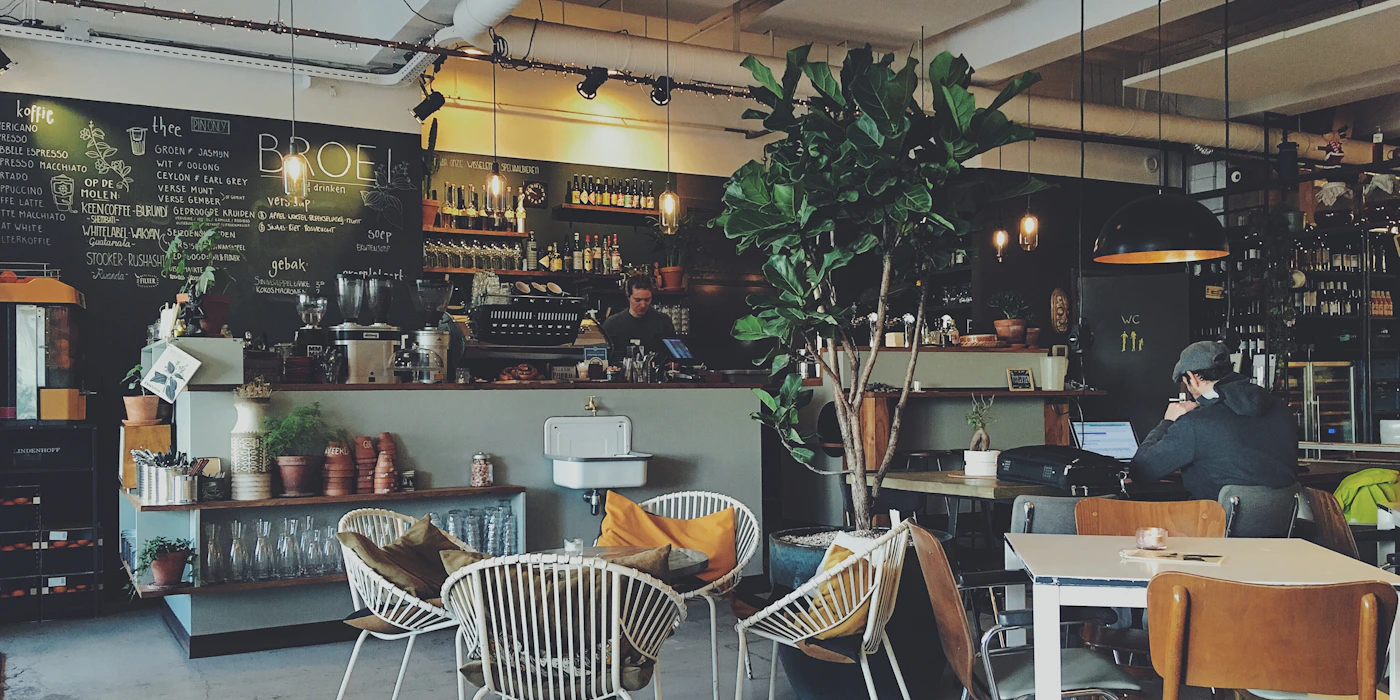
This is close to the perfect Krakow first date: a coffee in one of the cluttered, candle-lit cafés around Plac Nowy, where nobody rushes you and a short meeting can stretch if it's clicking or end gracefully if it isn't. Cheap, low-pressure, and built around conversation rather than performance — exactly the format the research likes.
A slow loop of the Planty park into the Main Square is a genuine local habit and a quietly excellent first date: side by side rather than across a table, easy silences covered by the city, a natural shape and a clean exit. Keep it short, fold it into a coffee if it's going well, and let the square do the talking when conversation dips.
In summer, a drink on the Bulwary Wiślane or a barge bar under Wawel is a scenic, casual first date with the river and the castle doing the heavy lifting. Short, cheap and easy to extend into a walk — the kind of low-stakes outdoor plan that lets repeated, relaxed exposure work.
Kazimierz after dark is built for drifting — one courtyard bar to the next, a zapiekanka from the round hatch, a buzzy crowd. A wander with a drink in hand is a low-stakes plan with built-in talking points, and because the same regulars are always there, it doubles as one of the best ways to keep seeing someone after the first date.
When a grey Krakow winter rules out lingering outdoors, the Rynek Underground museum beneath the square or the MOCAK contemporary art museum in Podgórze is a warm, conversation-friendly fallback — something to look at, no pressure to fill every silence. Keep it to an hour, then move on to a café nearby.
A wander up Wawel — the castle, the cathedral, the riverside dragon — is a small shared outing with a view and a bit of novelty, central and easy to keep light. Good for either stage: short enough not to overwhelm a first date, scenic enough to be a treat on a second.
Save the big-novelty trip for when you already like them. A day in the mountains south of the city is the self-expansion date in its purest form, but it's a whole day with travel at both ends and nowhere graceful to bail if it stalls. Brilliant as a reward for a good first date; a high-stakes gamble as the audition itself.
A long, proper dinner in an Old Town cellar or a Kazimierz restaurant is a lovely second date and a high-pressure first one — too long, too much eye contact before you know whether you want it. Bank the conversation on a café or a riverside walk first, then graduate to the table.
100% free until January 2028
LoveCertain matches you on values, life stage, attachment and communication — the four things that predict a lasting relationship. No card required.
Where people actually meet (beyond the apps)
Apps are used in Krakow, but in a centre this small and this café-driven the offline route matters more here than almost anywhere. The propinquity research points at what an app can't hand you: repeated, unforced contact at a time you're reliably free. The people who date well in Krakow tend to have a recurring anchor — a degree or a language course, a climbing or running group, a board-game or film club, a regular café where the staff know your order, a five-a-side team, a volunteer shift. In a young, churning student city, the steadiness is everything, because it's the only thing that turns a familiar face into a first date. If you only change one thing, make it this: pick one regular thing and keep showing up.
Krakow's academic calendar isn't a footnote — it's the calendar. From autumn to early summer the cafés, the Planty and Kazimierz do the propinquity work for you, so that's the time to be out and meeting people. The mistake is going dormant when the students leave and the tourists arrive, and letting your repeated-contact loop reset. Keep one summer-proof anchor — a riverside run, a sport, a local bar — running through July and August so the curve never breaks.
In a student city the pool feels bottomless, which quietly sabotages people: why invest, when someone newer is one swipe away? Rusbult's investment-model research is the corrective — commitment grows from what you build together, not from keeping every option open. Pick the promising person in front of you and actually invest a few weeks before deciding. The abundance is real; so is the cost of never landing anywhere.
For the meeting itself, the fundamentals travel: our notes on first date conversation apply at a Plac Nowy café exactly as they do anywhere, and the daytime date ideas guide leans into the short, low-key format Krakow's café culture rewards most. If you're weighing how this small, walkable city compares to others in the region, the Warsaw guide shows the faster, bigger-city Polish version, while the Prague guide is the closest cousin — another compact, beautiful, student-heavy Central European capital built for wandering. For the bigger picture on building relationships rather than collecting matches, the online dating cluster and our notes on the early stages of dating pull the research together.
One myth worth retiring: Krakow is not "just a stag-do town and a student churn, impossible to meet anyone real in." What gets blamed on the city — that everyone's young and leaving, that the centre is all tourists, that summer is dead — is usually a mix of genuine churn and a habit of going quiet when term ends. Lean into the smallness — the same faces passing you on the Planty week after week is propinquity, not a dead end — front-load term time, keep an anchor through the summer, and treat Wawel and the Tatras as openings rather than scenery. Most of that supposed difficulty turns out to be ordinary effort that nobody made. (For anyone dating across a real distance — common in a city this transient, with people forever heading back to Warsaw, Wrocław or abroad — the logistics in our long-distance relationship guide carry over almost intact.)
Weekly insights on attachment, relationships and finding lasting love.
The short version
Dating in Krakow gets easier the moment you stop treating it as a weekend and start using its real strengths — a tiny walkable centre, a student population that keeps the city churning, a deep café culture built for low-stakes meeting, and the Vistula and the Tatras within reach. Pick an area near home — the Old Town and Planty, Kazimierz, the riverside and Podgórze, the student quarter — and build a recurring routine around its cafés and squares. Front-load term time when the propinquity effect has somewhere to work, keep one summer anchor, and resist the student-city trap of always reaching for the next match. Keep first dates short, sociable and built around a coffee or a walk, and treat Wawel and Zakopane as openings rather than scenery. None of this is romantic advice in the usual sense — it's logistics. But in a city this small, showing up consistently is the romance. For the evidence on what actually builds lasting relationships, see how our matching works.
For more on how people meet today, the Pew Research Center keeps a clear, current overview of online dating and the trends behind it — useful context for a university city refilled every autumn with people who arrived to study and decided to stay.
Related reading


100% free until January 2028
You’ve got the date sorted — LoveCertain helps with the who, matching you on values, life stage, attachment and communication. No card required.